 |
Maki
Formally verfied low-code orchestration
|
|
Maki
Formally verfied low-code orchestration
|



MAKI is an open-source low-code development platform for designing, orchestrating, generating, and formally verifying ROS 2 robotic systems. It provides graphical modelling tools built around the KODA domain-specific language (DSL), with support for capability-based robot architectures, behavioural and data modelling, code generation, and formal verification.
MAKI is developed as part of research into model-driven engineering, low-code development, software architecture, and formal methods for robotics.
For more information, check out the documentation and these papers:
Developing a robotic application requires reasoning about several interconnected concerns: what functionality a robot provides, how that functionality is composed into tasks, what information is exchanged between components, and whether the resulting behaviour satisfies its requirements.
MAKI separates these concerns into dedicated graphical views while keeping them connected through a common underlying model. This allows developers to work at the level of robot capabilities and application behaviour rather than directly composing ROS 2 nodes, topics, services, and actions.
At the core of MAKI is KODA, a domain-specific language for describing robotic systems independently of a particular execution or verification backend. Models created visually in MAKI are represented using the same concepts provided by KODA and can be transformed into executable or formally verifiable artefacts.
The platform currently focuses on:
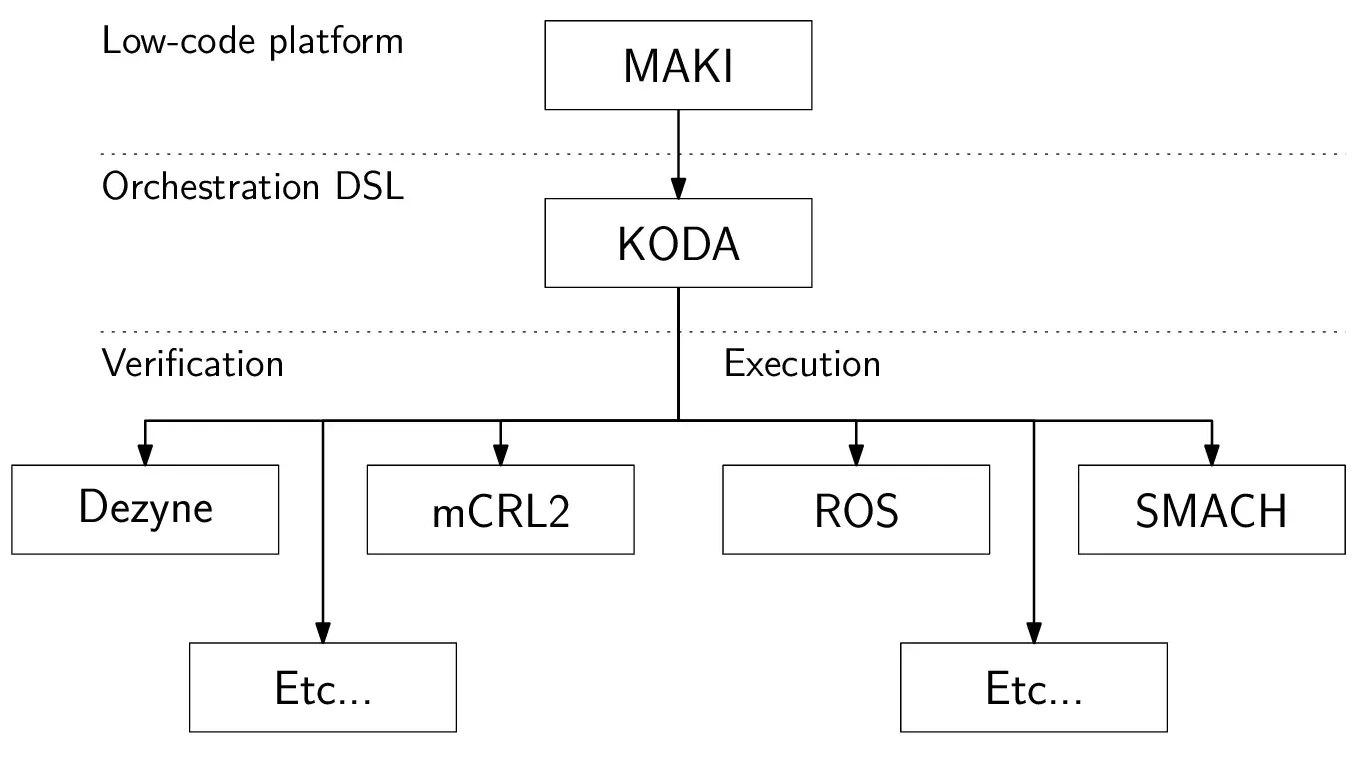
Rather than representing an entire robotic application in a single diagram, MAKI provides different views for different modelling concerns.
These views operate on the same underlying application model, allowing information defined in one view to constrain and assist modelling in another.
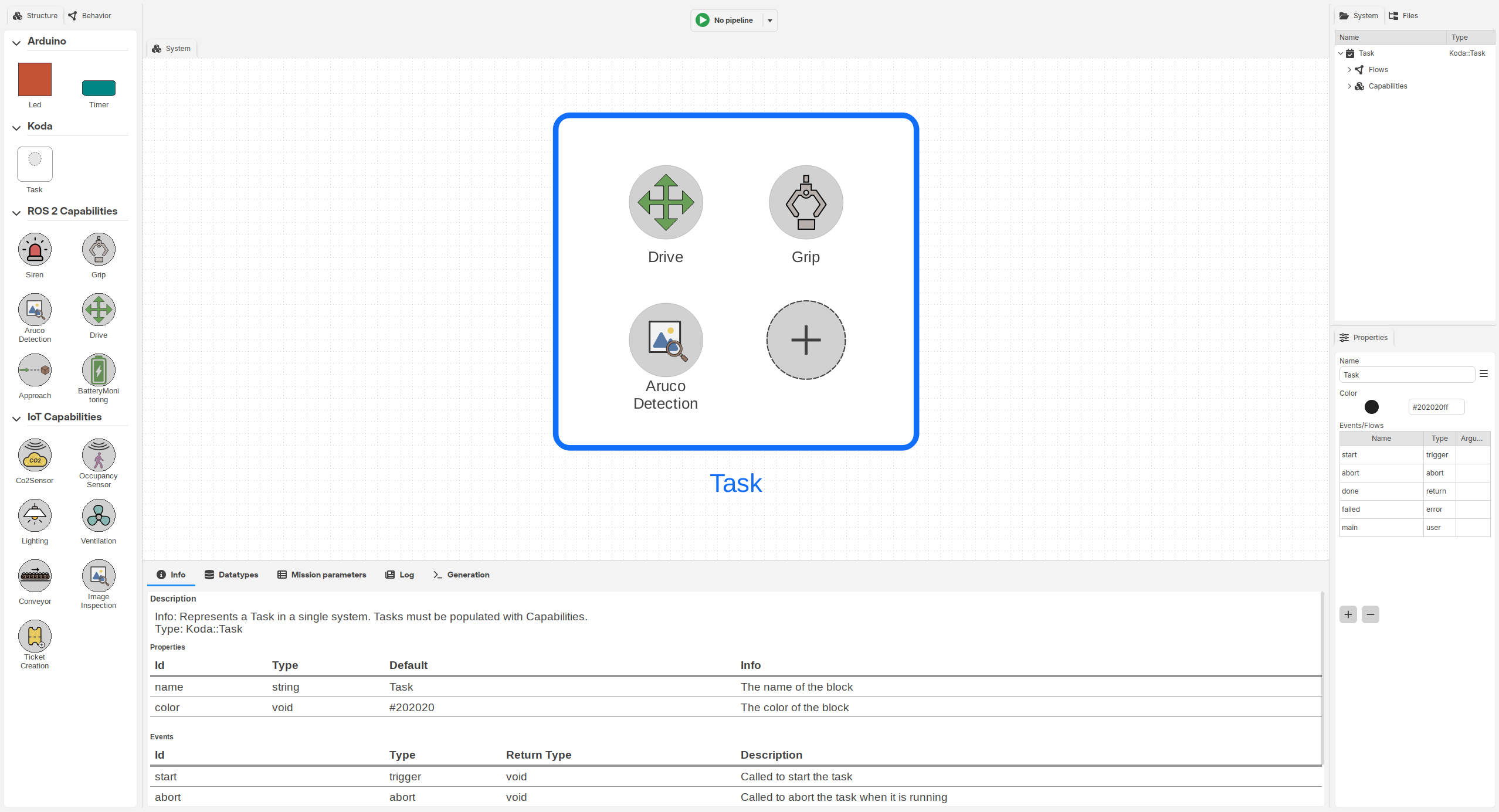
MAKI models robotic functionality through capabilities. A capability defines an interface to functionality provided by the robotic system, such as navigation, object detection, manipulation, or battery monitoring.
Tasks declare the capabilities they require. This separates application behaviour from the concrete components that provide it and enables capabilities to be reused across tasks and robotic platforms.
The example below shows a task composed of three required capabilities:
The behaviour of a task is described through flows. Flows visually compose capability calls and other flows using the orchestration constructs provided by KODA.
Simple behaviours can be expressed as sequences of operations, while more complex flows can introduce concurrency, synchronization, repetition, time constraints, and explicit handling of errors and aborts.
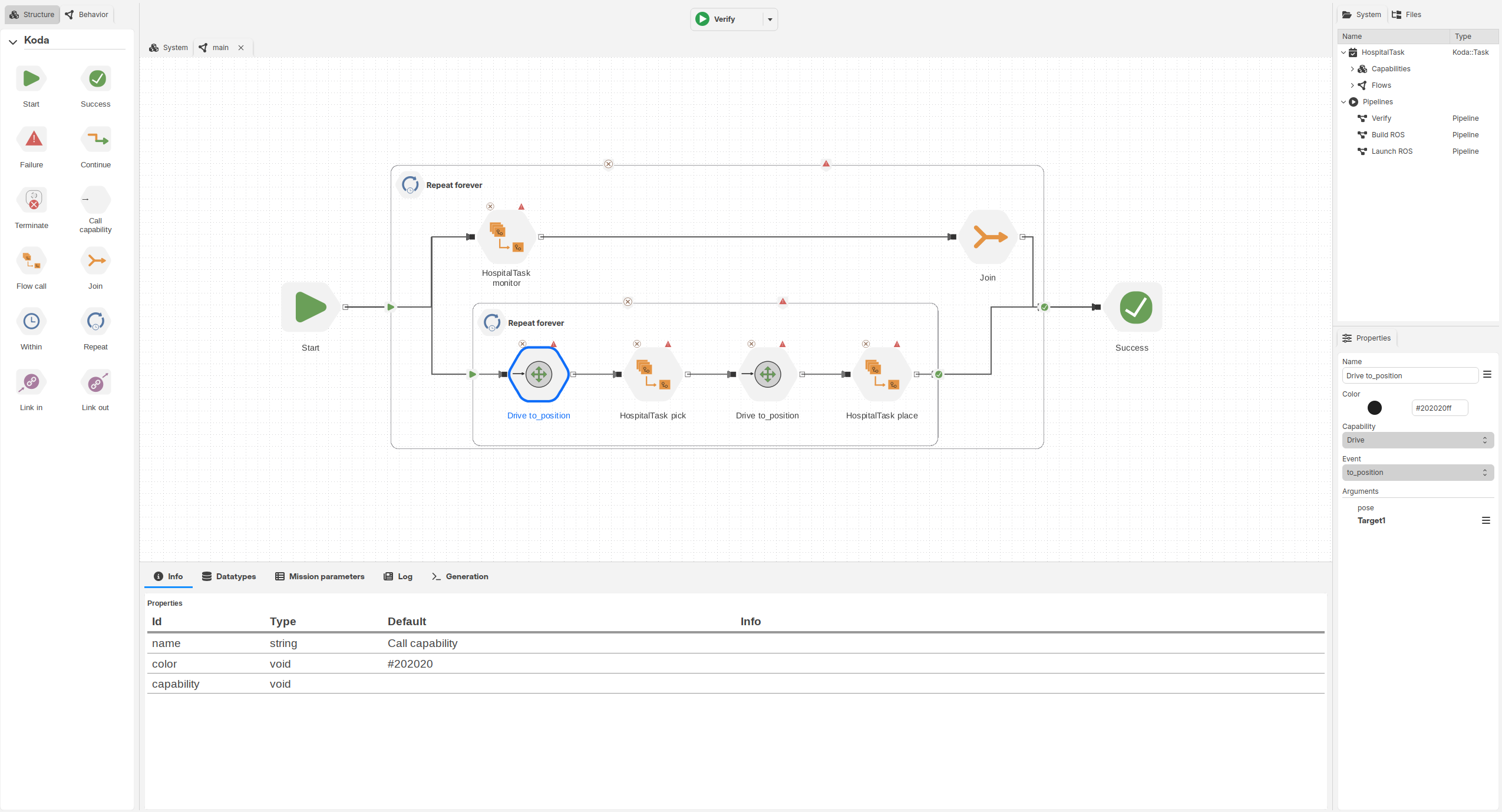
Because composite flows follow the same behavioural interface as individual operations, complex behaviours can be constructed hierarchically from smaller reusable behaviours.
Robotic behaviour often depends not only on which operations execute, but also on the information they produce and consume.
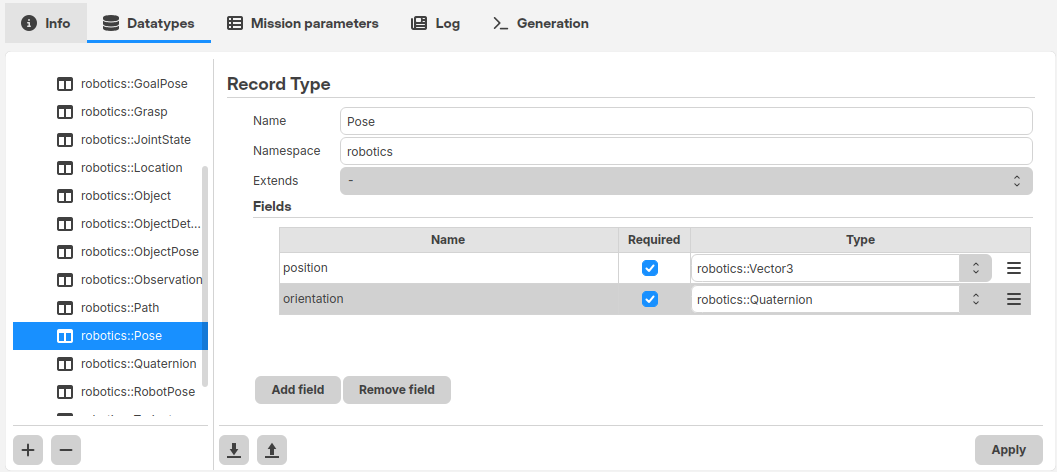
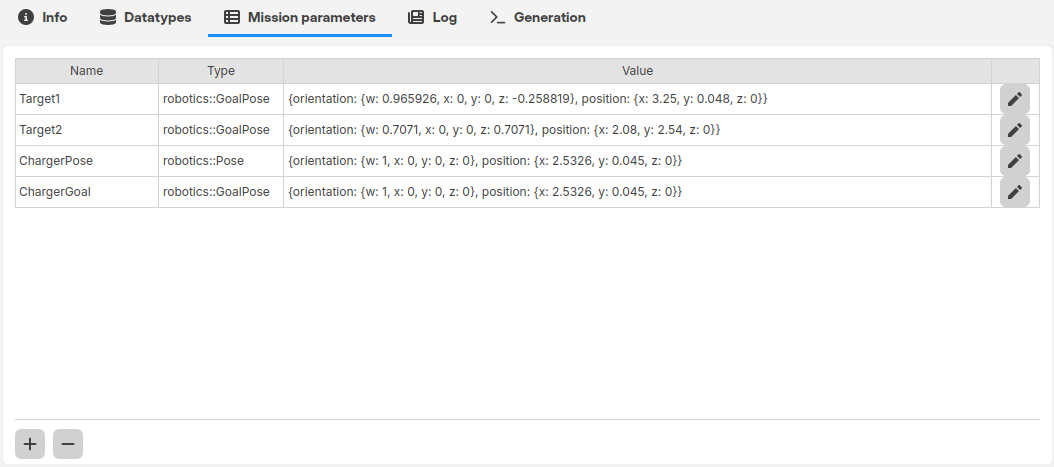
MAKI therefore models data as an explicit part of the application architecture. Capabilities can declare the information they produce and consume, while tasks can define parameters and project-specific data types.
Making these relationships explicit allows MAKI to detect inconsistencies across modelling concerns and provides the editor with additional information for assisting users when constructing application behaviour.
| 
|
| Data types | Mission parameters |
MAKI separates application modelling from the technologies used to execute or analyse the resulting system.
KODA models are compiled into an intermediate representation that can be consumed by different backend plugins. A backend may generate executable robotic software, translate the model into a formal verification language, or produce other application artefacts.
This separation allows the same application model to be used for multiple purposes without exposing backend-specific details in the graphical models.
Generating and executing a robotic application from MAKI.
MAKI supports plugins that provide generation actions. Individual actions can perform tasks such as generating source code, compiling an application, running verification, or deploying generated artefacts.
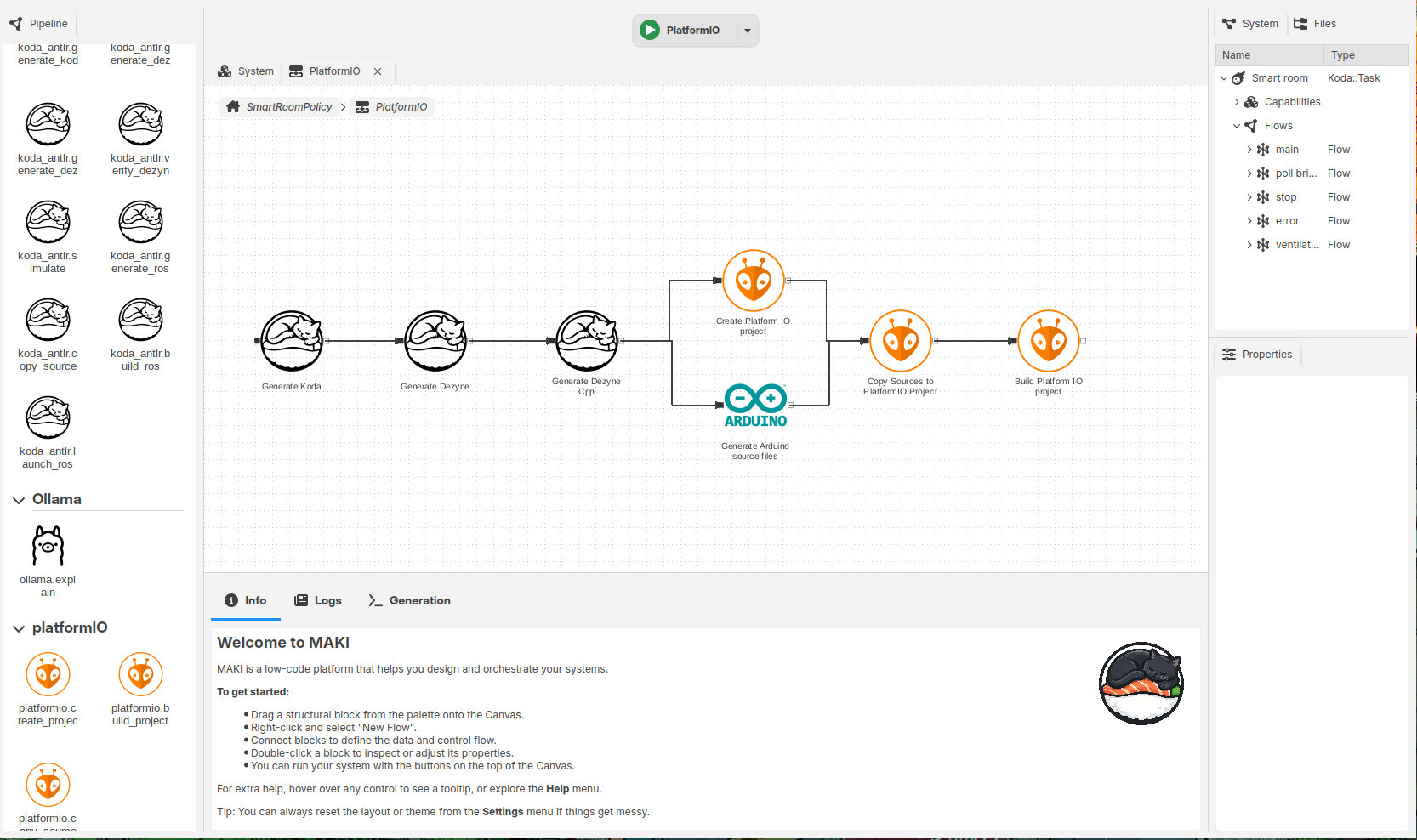
Generation actions can themselves be composed into visual pipelines. This makes it possible to define complete workflows while keeping individual generators independent and reusable.
The example below shows a generation pipeline composed of several actions:
MAKI is designed to support verification throughout the development process rather than treating it as a separate activity performed after implementation.
KODA models provide an abstraction of application behaviour that can be translated to formal verification backends. Developers can additionally define behavioural properties describing requirements that should hold for the resulting application.
This allows properties to be checked against the same application model used for code generation while keeping the details of the underlying verification technology hidden from the modeller.
See KODA Property Definitions for more information about defining properties in KODA.
The documentation is divided into the following sections:
MAKI is open-source and under active development. Contributions, bug reports, and feature suggestions are welcome through the MAKI GitHub repository.